The Seocheon Flower Garden offers fantasy writers more than a magical plant: it brings life-restoring and destructive power into one place. Start with the story, then decide what its tensions could do in a new fictional world.
The useful move is not to copy a flower name into an inventory. It is to ask who can reach the resource, what using it involves, and what happens when people disagree about its use.
What belongs to the traditional story?
The Igong Bonpuri is a narrative associated with Jeju shamanic ritual. In the account summarized by the Encyclopedia of Korean Culture, the Seocheon Flower Garden contains flowers that can restore life and flowers associated with destruction. A flower warden, the Kkotgamgwan, tends it.[1]
Hallakgungi travels to the garden, where his father recognizes him as his son. His father gives him flowers. Hallakgungi later uses them against the household that persecuted his mother and brings his mother back to life.[1]
That is a short account of one source basis, not a claim that every version is identical. Nor is it a universal rulebook for Korean religion. The story belongs to a ritual and narrative tradition, not simply to a collection of game mechanics.
For creative work, keep two separate notes: what the source actually says, and what you are choosing to invent. The questions below are design choices, not additional facts about the myth.
Who gets access to the resource?
The source account makes family recognition important to Hallakgungi’s encounter with the warden. A new fantasy setting can ask a different question: should access depend on descent, appointment, public duty, or something else?
Each answer produces a different kind of conflict. An inherited right creates a succession problem. A public appointment creates a political problem. A stolen permit creates a question of legitimacy. These alternatives are not interchangeable details; they decide who can act and who must ask permission.
Do not turn one episode into a claim that every person must pass the same moral test before receiving a flower. If your invented world needs that test, write it down as your own addition.
What procedure creates the tension?
Instead of deciding only what a magical resource does, decide what people must complete before its effect becomes possible. Perhaps they need a witness, an intact record, or time in a protected place. These are possible fictional procedures, not requirements being attributed to the Igong Bonpuri.
Choose a procedure that a character can interrupt or misunderstand. A rule that can never come under pressure may add background without generating a scene. A rule that requires two people to cooperate can put a relationship inside the magic itself.
What consequence belongs to your invented world?
The presence of restorative and destructive flowers in the same garden creates a productive contrast. It does not, by itself, establish that the flowers must always be harvested together, that one resurrection costs another life, or that the two powers are physically inseparable.
You may invent a scarcity, a prohibition, or a shared supply. Be explicit that you invented it. That distinction gives you room to make the system fit your story without presenting your decisions as inherited tradition.
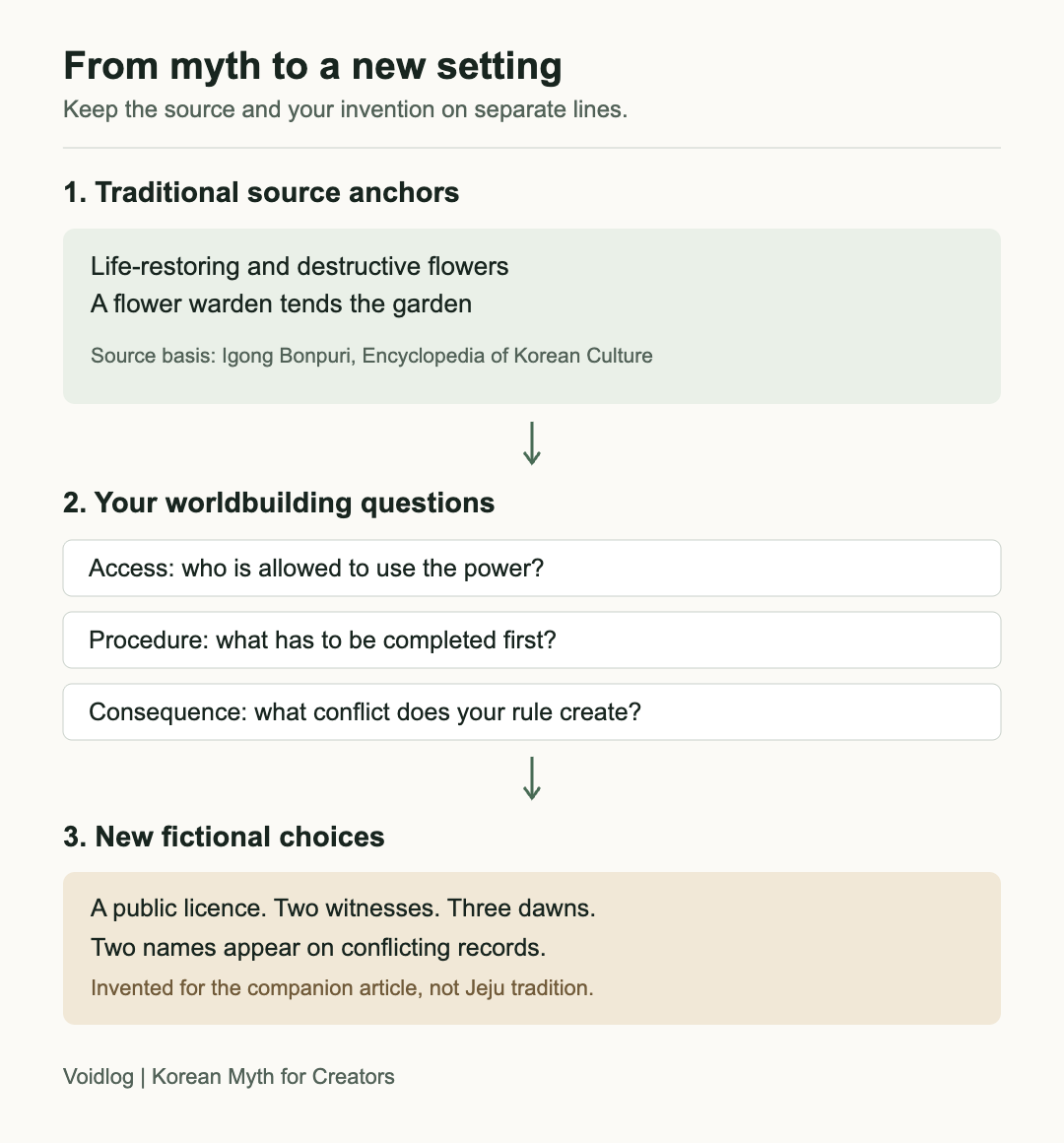
The diagram separates the source account from the decisions in the following example. It is an editorial design aid, not a historical map of the garden.
How could this become a new story?
Original fictional example: The City of Borrowed Spring. This city, its characters, and every rule in this paragraph are invented for this article.
A city maintains a garden whose seasonal licence is assigned at a public hearing. A restoration requires two living witnesses to agree on the name entered in a ledger. The hearing approves one licence, but the night before it takes effect, a clerk finds two different names on otherwise identical records.
One name belongs to a dead architect who alone knew how to repair the city’s failing reservoir. The other belongs to a child whose family has no political influence. If the witnesses cannot agree before the third dawn, the season passes without a restoration. The clerk must discover who altered the record while deciding whether a fair procedure can produce an unfair result.
The episode does not retell Hallakgungi’s journey. It takes a broad design question about controlled access to extraordinary power and develops a different conflict. The ledger, public hearing, licence, witnesses, deadline, and reservoir are new fiction, not Jeju tradition.
What can you take into your own project?
Write four short lines: the source you consulted; the element you kept; the rule you added; and the conflict that rule creates. If you cannot identify the addition, return to the source before making your claim stronger.
For a broader reference, Korean Myth for Creators organizes 21 bonpuri by creative use, alongside system breakdowns, variant notes, and planning worksheets. See what is inside the sourcebook. You can also view the Kindle edition and read its Amazon sample.
Source and production notes
[1] Igong Bonpuri, Encyclopedia of Korean Culture, Academy of Korean Studies. Source consulted on October 26, 2026. Traditional details above are a short original summary; the three design questions and the fictional example are editorial additions.
This article was prepared with AI tools. It is a publisher-created companion article, not an independent review. It does not reproduce a book chapter. The sourcebook’s English translation and review against the Korean original were also carried out with AI tools.