A bonpuri sourcebook for writers and worldbuilders
Build a fantasy setting with Korean myth as a starting point, while keeping traditional stories, variant versions, and new invention distinct.
Korean Myth for Creators: 21 Shamanic Myths, Sorted for Web Novels, Webtoons & Games is an English-language reference for web-novel writers, webtoon creators, game narrative designers, and screenwriters. It is written for readers who do not already know Korean mythology.
View the Kindle edition and read a sample on Amazon
What can you use it for?
Find narrative material by the problem you are trying to solve: a revenge plot, a self-directed hero, an underworld administration, a creature encounter, or a ritual specialist. Then move from a story outline to the rules, roles, and conflicts of your own setting.
The emphasis is on use, not on treating every deity or creature as a collectible entry. The book identifies source bases and discusses variants, but it is not a critical edition of ritual transcripts or a substitute for specialist scholarship.
What is inside?
- 21 bonpuri arranged in six creative-use groups.
- Four worldbuilding system breakdowns: the flower garden, underworld administration, underworld economy, and household gods.
- Notes on common misconceptions and differences between recorded versions.
- Structural readings of modern Korean entertainment, with confirmed links distinguished from interpretation.
- Three planning worksheets, an integrated demonstration, and clearly identified creative examples.
- Seven diagrams, 13 illustrated plates, source guidance, and a use-based index.
Try the method before choosing the book
Read the companion article on the Seocheon Flower Garden. It begins with a brief sourced account and develops a new fictional problem. Traditional material and new decisions are labelled separately.
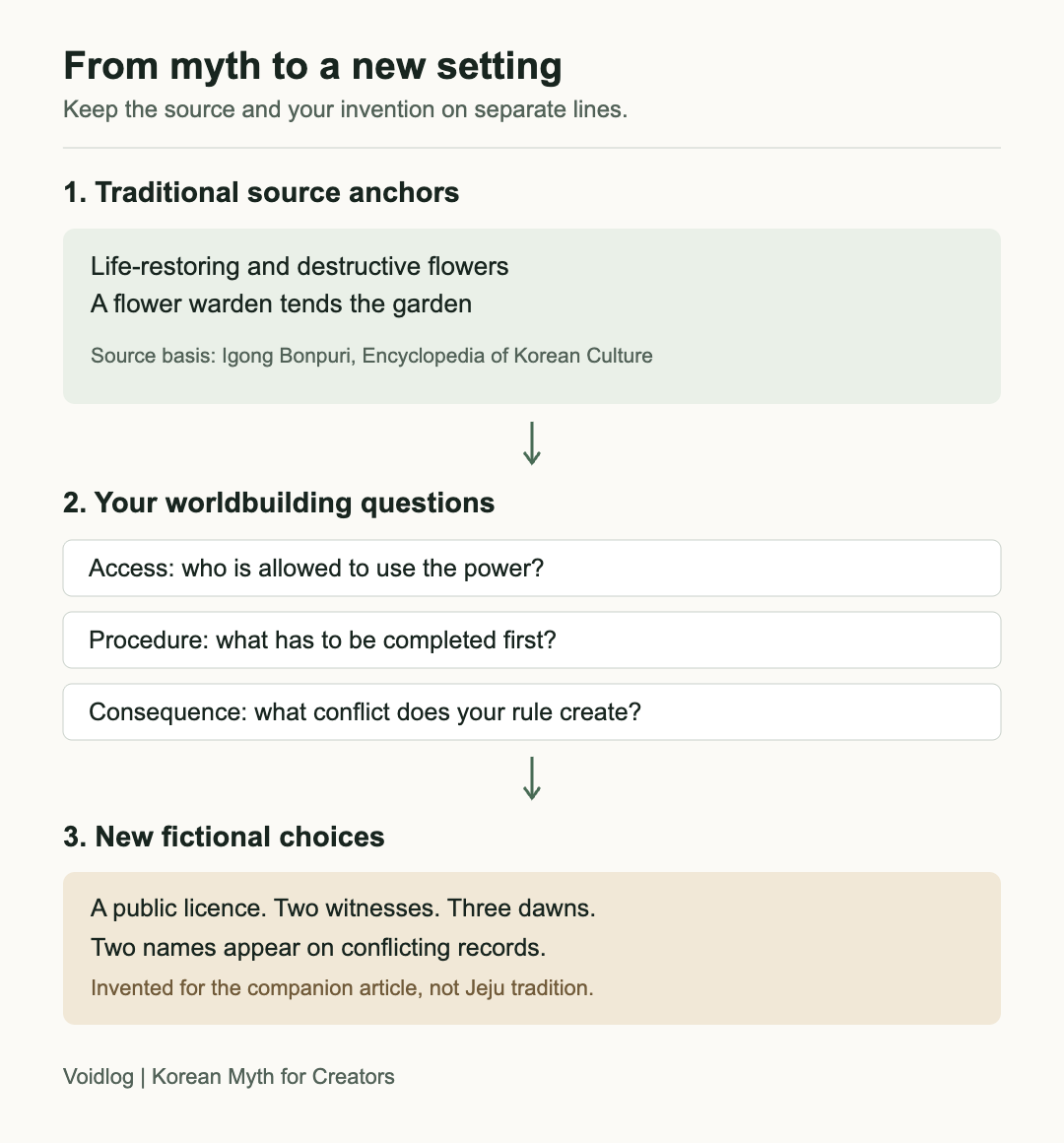
The companion diagram illustrates the method. It is newly prepared for the website rather than reproduced from the ebook.
Is this the right reference for you?
It may fit if you want prompts and structures for developing a story, not simply a general introduction to Korean mythology. If you need complete transcriptions, a historical-critical edition, or permission to reuse someone else’s modern retelling, this book does not supply those things. Consult the original sources and the relevant rights conditions for your project.
Book and production information
Author and translation responsibility: Bookmining Content Research Team. English-edition publisher: Voidlog. Format: Kindle ebook. ASIN: B0HP57T5NH.
Translation note: AI tools were used to translate this edition from Korean and to review the translation against the Korean original. The book includes AI-generated writing and an AI-generated cover silhouette. Museum images and scripted diagrams are credited separately in the book.
This page is published by the book’s publisher. It is not an independent review and makes no claim about reader ratings or sales results. Check current price, regional availability, and subscription options on Amazon.